Summary
Fall sun glare can make an Atlanta commute dangerous within seconds. When the sun sits low on the horizon, drivers may have difficulty seeing brake lights, traffic signals, lane markings, pedestrians, cyclists, or stopped vehicles. Sun glare does not automatically excuse a crash, and it does not automatically prove negligence. Fault usually depends on what each driver did before impact and whether the evidence shows that someone failed to use reasonable care under the conditions.
The Keenan Law Firm represents people injured in automobile accidents in Atlanta, Georgia. In a sun-glare collision, the central question is rarely whether the sun was bright. The more useful question is whether a driver adjusted speed, following distance, attention, and vehicle control when reduced visibility became apparent.




Why Fall Sun Glare Can Create Driving Problems in Atlanta
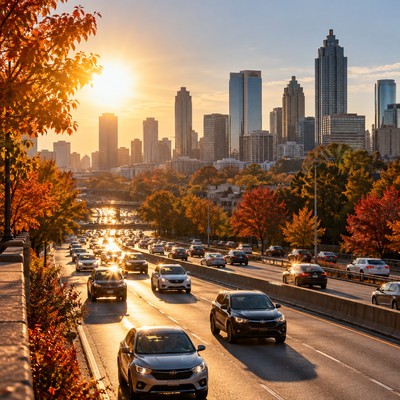
Sun glare can occur throughout the year, but lower sun angles during fall mornings and late afternoons can place bright light directly in a driver's line of sight. Eastbound drivers may face glare after sunrise, while westbound drivers may encounter it closer to sunset.
In Atlanta, those conditions can overlap with busy commuting periods on I-75, I-85, I-285, GA-400, and major surface roads.
Glare can reduce contrast and make objects ahead harder to distinguish. A driver may have difficulty seeing:
- Slowing or stopped traffic
- A red traffic signal
- A pedestrian entering a crosswalk
- A vehicle changing lanes
- Road debris or another hazard
- Brake lights on a vehicle ahead
A dirty windshield, worn wiper marks, interior haze, or poor visor positioning can make visibility worse.
The presence of glare does not end the liability analysis. Drivers are expected to use reasonable care under the conditions they encounter. When glare reduces visibility, practical safety steps may include reducing speed, increasing following distance, repositioning a visor, or taking another reasonable step to maintain a clear view and control of the vehicle. Whether a specific action was reasonable depends on the facts of the collision.

Katherine Rinaldo


Matthew Powell

Don Truskett

Michael Strong
Georgia Law Focuses on Driving Conduct
Georgia negligence claims generally examine whether a person failed to use ordinary or reasonable care and whether that failure caused the collision and resulting injuries.
Traffic laws can also become relevant when visibility is reduced.
O.C.G.A. § 40-6-180 requires drivers to operate at a speed that is reasonable and prudent under the conditions and with regard to actual and potential hazards. A posted speed limit does not mean that the posted speed is appropriate in every condition. If glare seriously limits a driver's ability to see traffic ahead, the driver's speed may become part of the fault analysis.
O.C.G.A. § 40-6-49 addresses following too closely. Drivers must leave a reasonable and prudent distance based on speed, traffic, and highway conditions.
If a driver rear-ends a stopped vehicle and later says that the sun blocked the view, investigators may examine whether the driver reduced speed, maintained enough distance to react, and took reasonable steps once the visibility problem became apparent.
For a broader discussion of accident liability, see How to Prove Fault in a Georgia Car Accident Case:
https://www.keenanlawfirm.com/how-to-prove-fault-in-a-georgia-car-accident-case/
What Evidence Can Prove Fault in a Sun-Glare Crash?
Sun-glare cases can depend heavily on physical and digital evidence because lighting conditions change quickly. Ten or twenty minutes after a crash, the sun may be at a different angle and the roadway may look different.
Evidence can help establish what the conditions were at the time of the collision.
Useful evidence may include:
- Photographs and video taken close to the time of the collision
- Dash-camera footage showing the driver's view before impact
- Nearby business or residential surveillance video
- Traffic-camera footage, when available
- Witness statements about glare, speed, braking, or lane position
- The police crash report and officer observations
- Vehicle damage patterns
- Debris locations and final vehicle positions
- Tire marks or roadway gouges
- Event data recorder information, when available
- GPS or telematics information, when relevant
- Phone records when distraction is disputed and the records are lawfully obtained
- Weather and solar-position data for the time and location of the crash
- Photographs of the windshield, visor, tint, mirrors, or other visibility-related features
Dash-camera footage can be especially useful because it may show the direction of travel, the intensity and angle of the sunlight, the distance to traffic ahead, and when braking began.
More information is available in The Role of Dash Cams in Georgia Car Accident Cases:
https://www.keenanlawfirm.com/the-role-of-dash-cams-in-georgia-car-accident-cases/
Evidence should be preserved as early as possible. Video may be overwritten, vehicles may be repaired, and witnesses may become harder to locate.
See Evidence Preservation in Georgia Car Accident Cases:
https://www.keenanlawfirm.com/evidence-preservation-in-georgia-car-accident-cases/
Can a Driver Blame the Sun for the Accident?
A driver can explain that sun glare affected visibility, but that explanation does not automatically eliminate responsibility.
The legal issue usually centers on whether the driver acted reasonably after the visibility problem became apparent.
Consider a motorist traveling west in Atlanta during the late afternoon. The sun is directly ahead, and traffic begins slowing for congestion.
If the driver continues at the same speed, follows closely, and crashes into the rear of another vehicle, the investigation may focus on whether the driver should have reduced speed or increased following distance once visibility became limited.
A different collision may involve more complicated facts. One vehicle may suddenly enter another lane. A traffic signal may be difficult to see. A driver may stop unexpectedly. Several drivers may make separate mistakes.
In those situations, sun glare may be one factor without being the only cause of the crash.
The same principle applies when an injured driver is accused of contributing to the collision. A proper investigation should examine the conduct of every involved driver instead of treating sun glare as a complete excuse or automatic proof of negligence.
Verdicts & Settlements
How Georgia Comparative Fault Can Affect a Claim
Georgia follows a modified comparative fault system under O.C.G.A. § 51-12-33.
If an injured person is assigned part of the responsibility for a collision, recoverable damages can be reduced according to that person's percentage of fault. If the injured person is 50 percent or more responsible, Georgia law generally bars recovery.
This rule can matter in sun-glare crashes because more than one driver's conduct may be disputed.
For example, one driver may have failed to reduce speed after visibility became limited while another driver made an unsafe lane change. The evidence may need to separate those actions and show how each contributed to the collision.
For more information, see Understanding Georgia's Comparative Negligence Laws in Auto Accident Cases:
What Should You Do After a Sun-Glare Car Accident?
Your health should come first. Seek emergency treatment when necessary, and obtain medical evaluation if you are injured or begin developing symptoms after the crash.
If you can safely document the scene, take photographs facing the direction each vehicle was traveling. Try to capture the horizon, roadway, lane markings, traffic signals, nearby buildings, trees, and other objects that may have affected visibility.
You should also consider these steps when they can be completed safely:
- Photograph the vehicles from several angles.
- Record the approximate location and direction each vehicle was traveling.
- Identify witnesses and obtain their contact information before they leave.
- Save dash-camera footage immediately so that it is not overwritten.
- Preserve photographs, videos, repair documents, medical records, and insurance communications.
- Provide accurate information to responding police officers and medical providers.
- Avoid guessing about speed, distance, legal responsibility, or injuries that have not yet been evaluated.
A witness may have noticed whether the sun was directly in a driver's line of sight, whether traffic was slowing, whether brake lights were visible, or whether a vehicle changed lanes immediately before impact.
Statements made at the scene may later become part of the liability investigation. Describe what you observed as accurately as possible without speculating about facts you do not know.
Insurance Issues After a Sun-Glare Crash
Insurance companies may investigate liability, vehicle damage, medical causation, treatment history, lost income, prior medical conditions, and available insurance coverage.
A supported claim should connect the collision evidence to the injuries and financial losses being claimed.
Depending on the facts, recoverable damages may include:
- Medical expenses
- Future medical treatment
- Lost wages
- Reduced earning capacity
- Property damage
- Pain and suffering
- Disability or impairment
- Other damages available under Georgia law
The amount that may be recovered depends on the evidence, available insurance coverage, the nature and severity of the injuries, and any allocation of fault.
If the responsible driver has little or no insurance, uninsured or underinsured motorist coverage may also need to be reviewed. Policy language, available limits, and notice requirements can affect the coverage analysis.
How an Atlanta Car Accident Attorney Can Help
A sun-glare accident may require more investigation than a police report and vehicle repair estimate.
An attorney may help:
- Investigate how the collision occurred
- Preserve dash-camera, surveillance, and other video evidence
- Interview witnesses
- Review police reports and photographs
- Inspect the vehicles and roadway evidence
- Evaluate available insurance coverage
- Examine comparative fault allegations
- Document injuries and financial losses
- Consult qualified experts when lighting conditions, visibility, speed, or crash reconstruction are disputed
An attorney can also examine whether the other driver adjusted to the conditions and whether fault arguments are supported by the available evidence.
Learn more about the firm's automobile injury practice:
https://www.keenanlawfirm.com/atlanta-automobile-injury-attorneys/
Speak With The Keenan Law Firm About an Atlanta Car Accident
If you were injured in a fall sun-glare collision in Atlanta, Georgia, The Keenan Law Firm can review the circumstances, available evidence, insurance issues, and fault arguments that may apply to your situation.
The firm handles automobile accident cases in Atlanta and can evaluate the facts that may affect liability and damages.
Contact The Keenan Law Firm online:
https://www.keenanlawfirm.com/contact/
The Keenan Law Firm serves clients in Atlanta, Georgia, and handles matters involving serious automobile injuries.
This article is for informational purposes only and is not legal advice. Every case depends on its specific facts and applicable law. Consult an attorney about your situation.